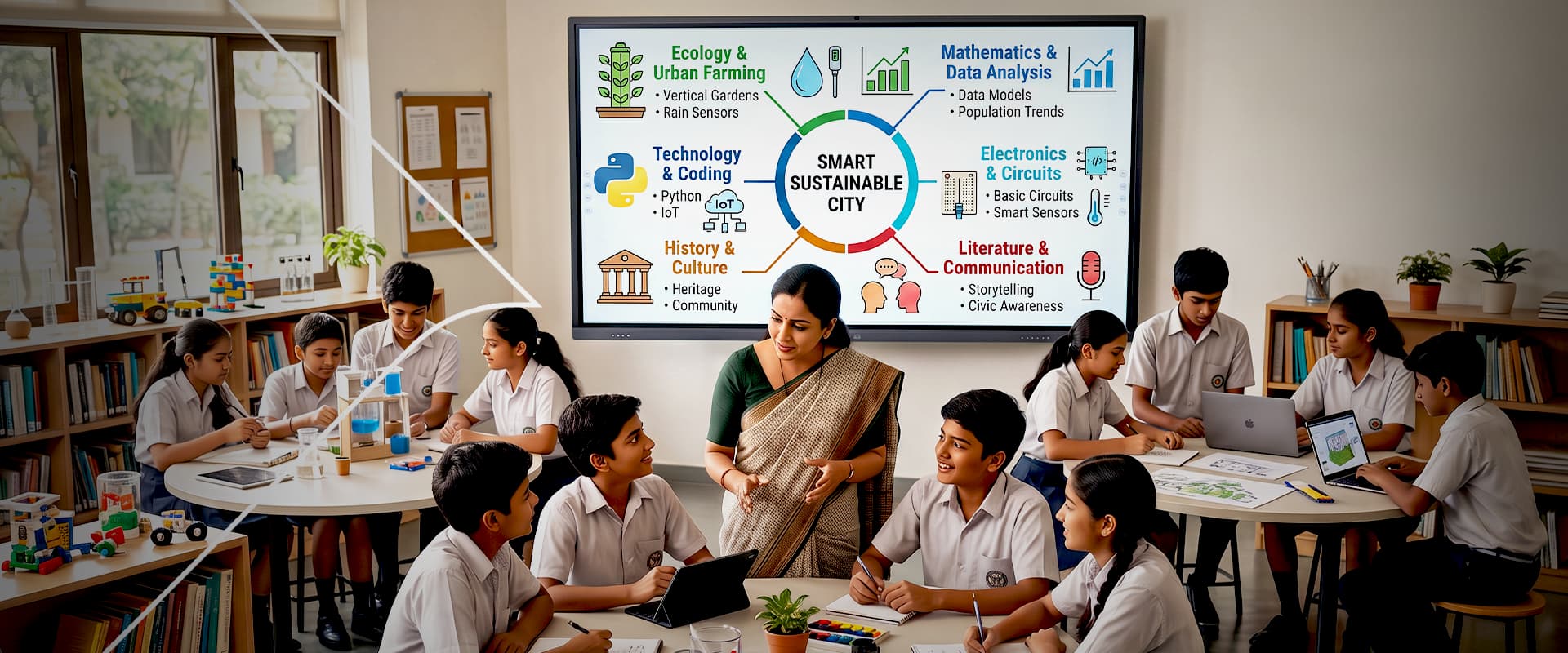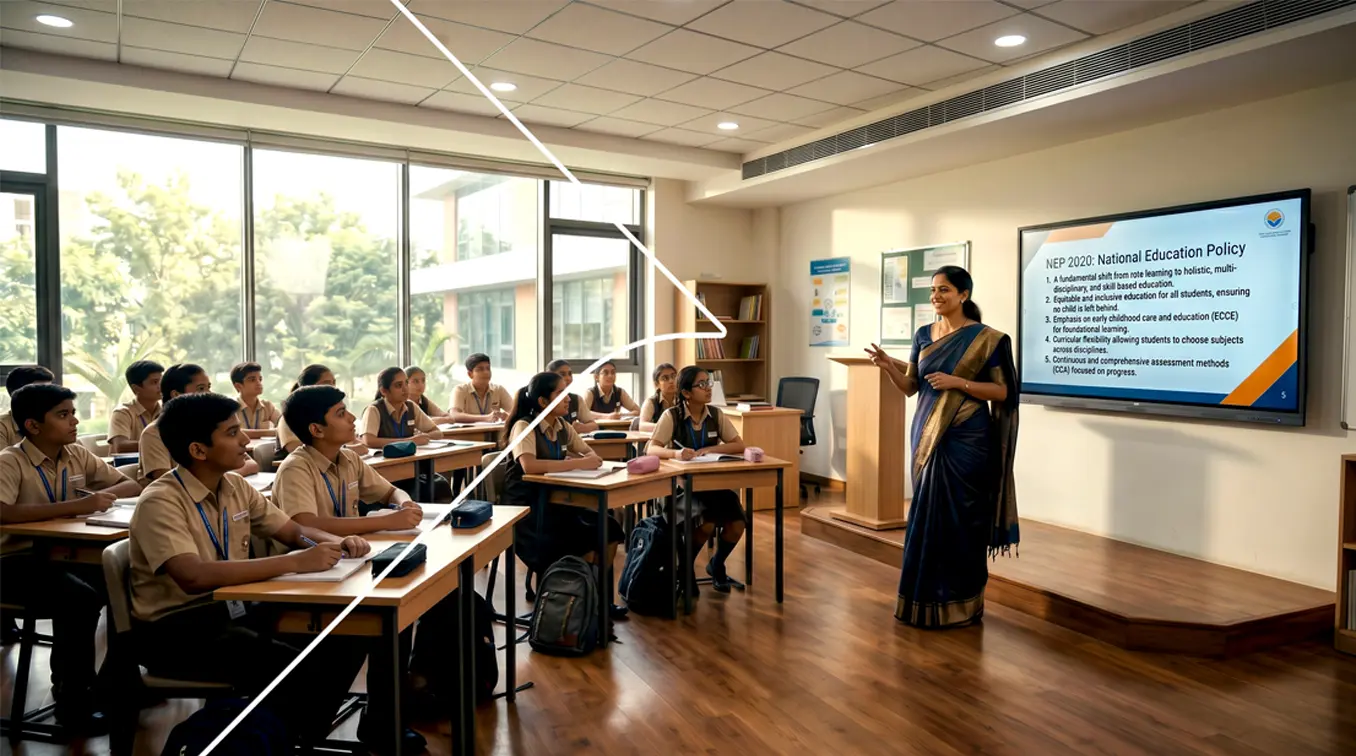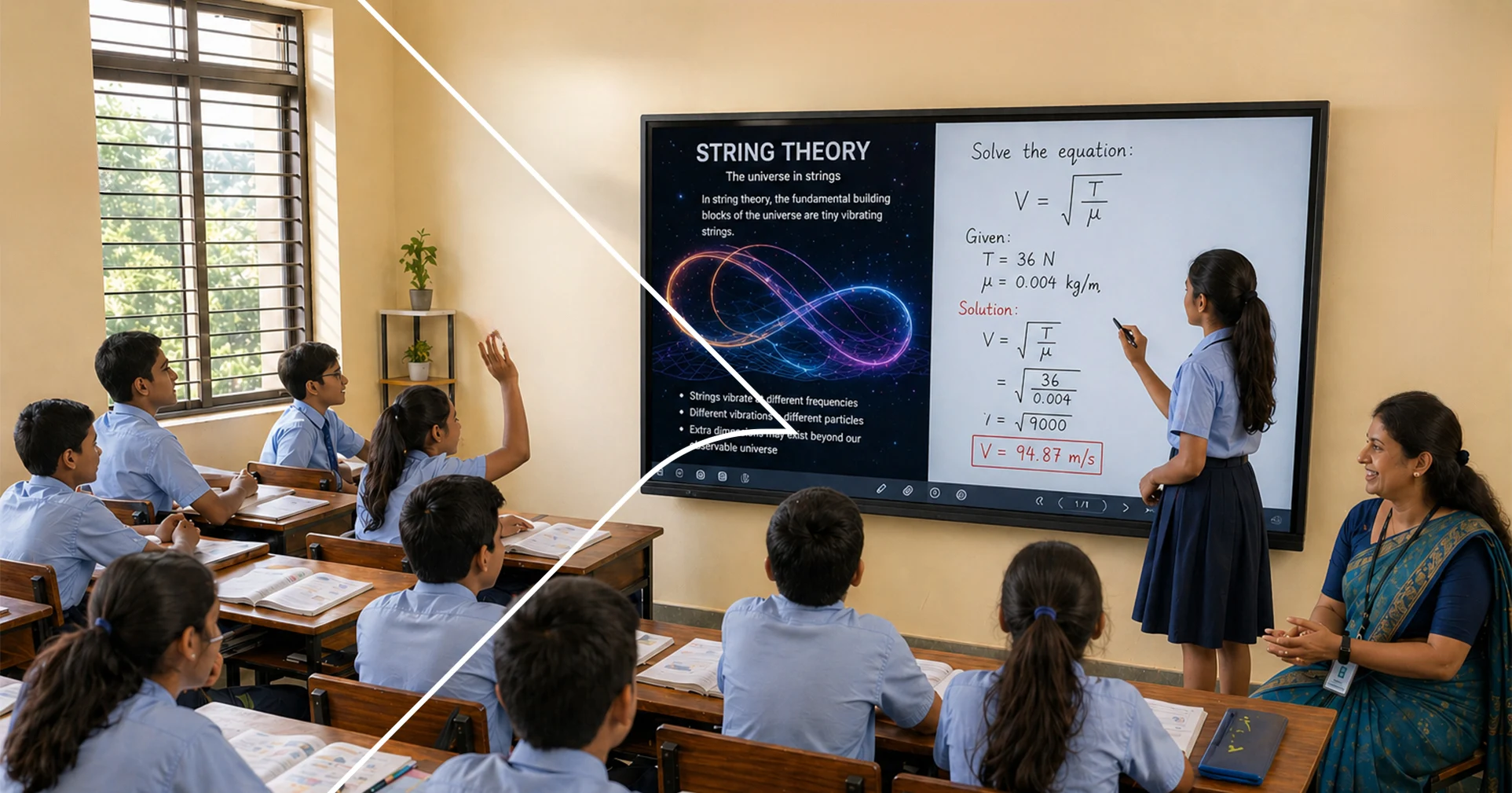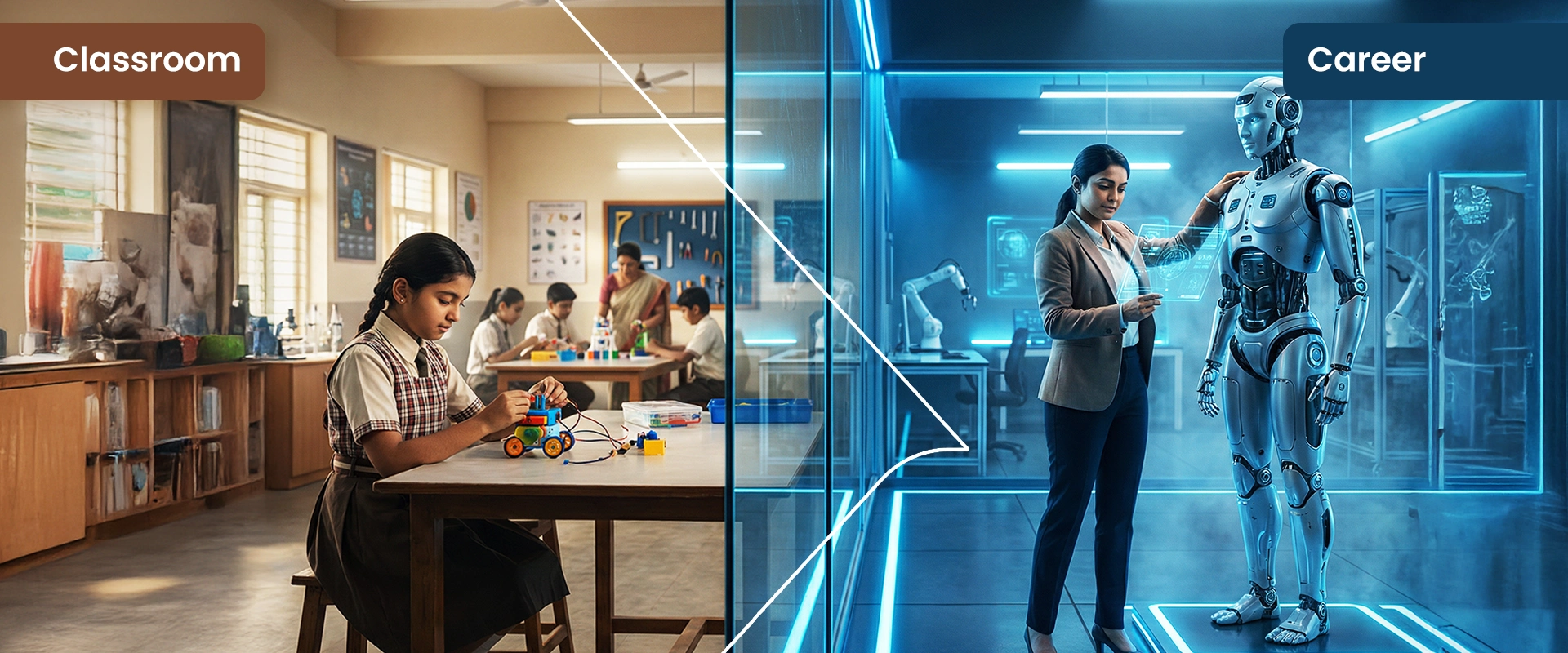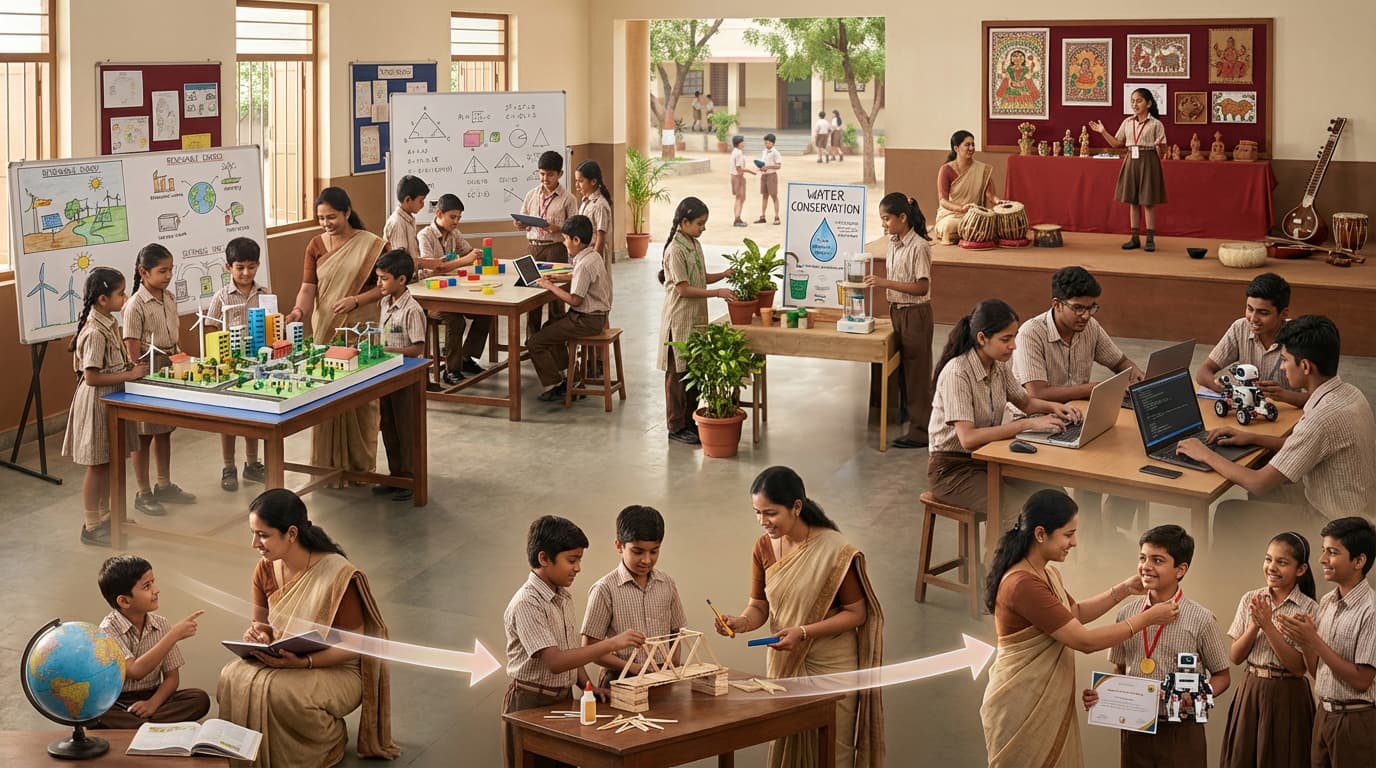


Education today is expected to prepare students for far more than examinations. Schools are increasingly focused on developing learners who can think critically, solve unfamiliar problems, collaborate effectively, and apply knowledge in meaningful contexts. This shift has prompted educators to re-examine not only what students learn but also how they learn.
Experiential learning aligns closely with these evolving expectations. Rather than treating knowledge as something transferred from teacher to student, it positions learning as a continuous process in which students bring their own knowledge, ideas, beliefs and practices, at different levels, to their understanding and interpretation of new information (Bartle, 2015). It offers a practical way to make classroom learning more relevant and engaging.
What Is Experiential Learning?
Experiential learning is an instructional approach in which students develop understanding by actively engaging with concepts rather than simply receiving information.
Experiential learning can be represented as a four-stage cycle where learning begins with experiences that allow participants to observe, review and reflect on what they have practiced, and then critically reflect to consciously link their experiences to theory or previous experiences (Bartle, 2015).
John Dewey, in his work Experience and Education (1938), placed experience at the centre of education, emphasizing that meaningful learning develops through learners’ active engagement with their environment. This idea was later developed into a four-stage cycle beginning with concrete experience, followed by reflective observation, abstract conceptualisation and active experimentation (Kolb, 1984; Bartle, 2015).
In practice, the learning cycle is more like a spiral learning process where theory and practice are conceptualised and reconceptualised, with each spiral deepening the student’s understanding (Kolb & Fry, 1975).
The principle is simple: experience alone does not guarantee learning. It is the combination of experience, reflection, and application that turns a classroom activity into lasting understanding.
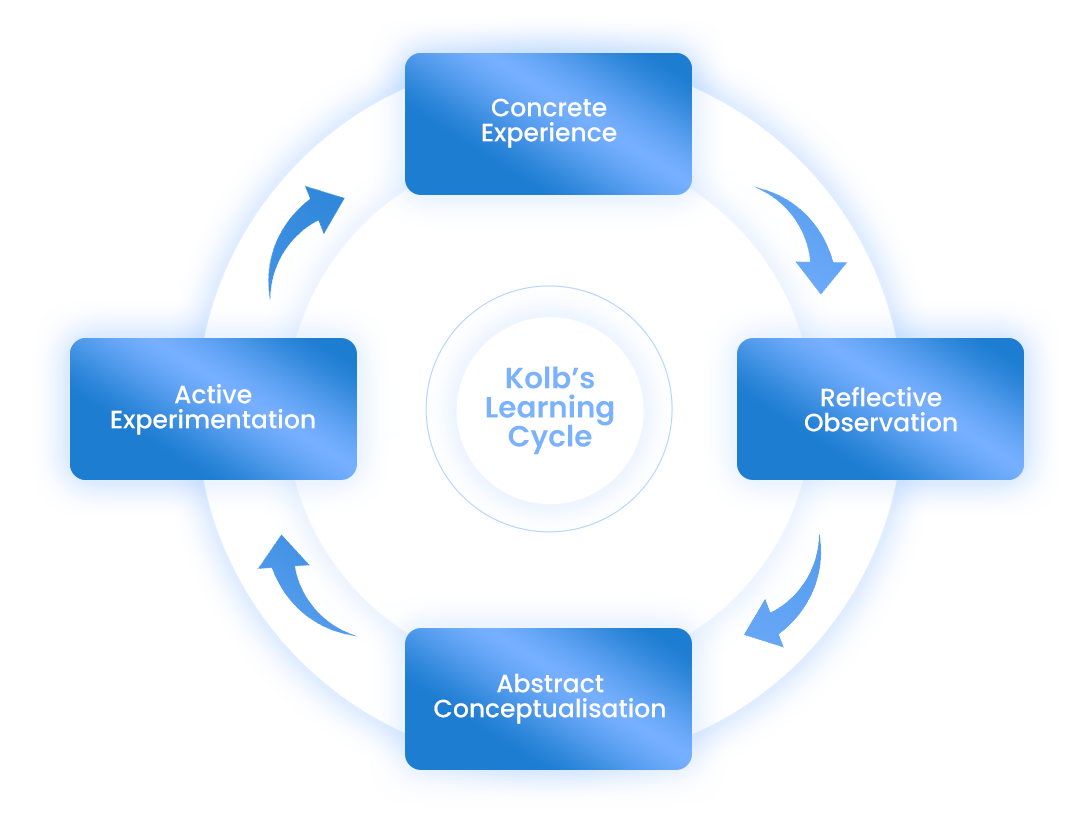
Kolb’s Experiential Learning Cycle (Kolb, 1984), recreated based on Bartle (2015).
Experiential Learning in Practice
Consider a student learning to ride a bicycle. The learning begins with concrete experience as the student attempts to ride and encounters challenges with balance and coordination. Through reflective observation, the student considers what happened and what caused the difficulty. The student then develops an abstract understanding of how balance, pedalling, and steering work together, before actively experimenting by adjusting these actions in the next attempt.
This illustrates a central idea of experiential learning: experience becomes learning when students engage with it, reflect on what happens, and use that understanding to improve their next attempt.
The same principle can be applied in the classroom. Reading about the water cycle may help students remember its stages, while building a closed water cycle in a sealed bag and watching condensation form, droplets slide, and precipitation occur gives students an opportunity to observe and experience the concept.
Why Experiential Learning Leads to Deeper Learning
The value of experiential learning extends well beyond engagement. It shapes how deeply students retain information, how independently they think, and how confidently they transfer knowledge to unfamiliar situations.
01
Stronger Retention and Recall
Research in cognitive psychology consistently finds that active, applied learning leads to stronger long-term retention than passive instruction (Prince, 2004).
02
Deeper Conceptual Understanding
Experiential learning allows students to observe, test, and apply ideas, helping them understand not just what a concept is, but why it occurs and how it can be used.

03
Development of Critical Thinking
Real problems rarely have a single predetermined answer. Experiential learning creates opportunities for students to take initiative, make decisions, investigate possibilities, and learn from the outcomes of their choices (Bartle, 2015).

04
Stronger Engagement and Ownership
Activities such as role-plays and debates encourage them to weigh evidence, consider perspectives, and build arguments, fostering greater curiosity and ownership of learning.
Reflection: The Bridge Between Experience and Understanding
Experience alone does not guarantee learning. A key distinguisher of experiential learning from other learning approaches is the requirement for students to continually self-evaluate their progression in the learning process through constant reflection (Fry et al., 2009).
Reflection enables students to examine what happened, why it happened, and how the experience connects to broader concepts. It is also the stage most often skipped, which is why some hands-on activities fail to translate into real learning.
Students must critically reflect on their experience, both while it is happening and subsequently, and consciously create meaning and conceptualisation from the experience (Gamble, Davey & Chan, 1999).
Structured reflection helps learners identify patterns, question their assumptions, and recognise misconceptions. Simple prompts such as What surprised you?, Why did this outcome occur?, or How would you approach this differently next time? push students to think beyond completing the task and toward understanding the process itself.
Over time, this practice builds metacognitive skill: students begin monitoring their own thinking, evaluating their strategies, and adjusting independently, a capability that supports learning well beyond any single subject.
Teachers' Role in Experiential Learning
Experiential learning is most effective when the experience is intentionally connected to the learning objective. The goal is not to add more activities to a lesson, but to create opportunities where students can explore concepts, make decisions, experiment with ideas, and learn from the outcomes.
This requires teachers to carefully select experiences that have a clear purpose and provide students with enough structure and resources to engage meaningfully with them (Bartle, 2015).
This approach also changes the teacher’s role. Rather than directing every step, teachers facilitate the learning process by setting clear expectations, providing appropriate support, and allowing students to investigate and work towards solutions independently.
Connecting the experience to the intended learning while giving students room to explore helps maintain a balance between the academic and nurturing aspects of teaching (Bartle, 2015).
Well-designed learning environments can further enable this by providing students with opportunities to explore concepts, experiment with ideas, and engage with learning in meaningful ways. ClassEdge Platinum brings these opportunities into the classroom through interactive, curriculum-aligned learning experiences.
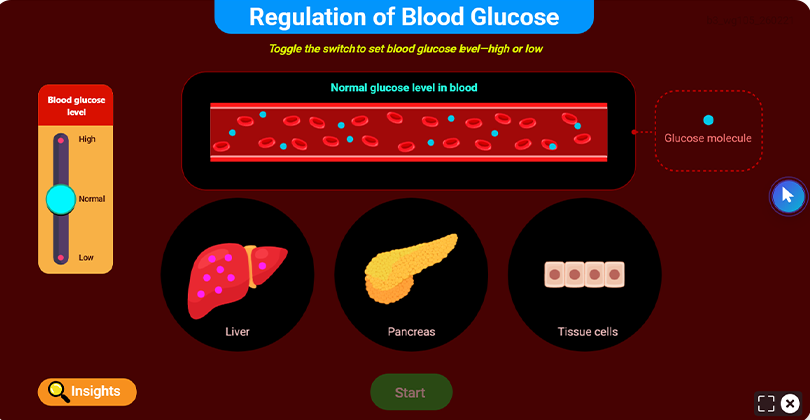
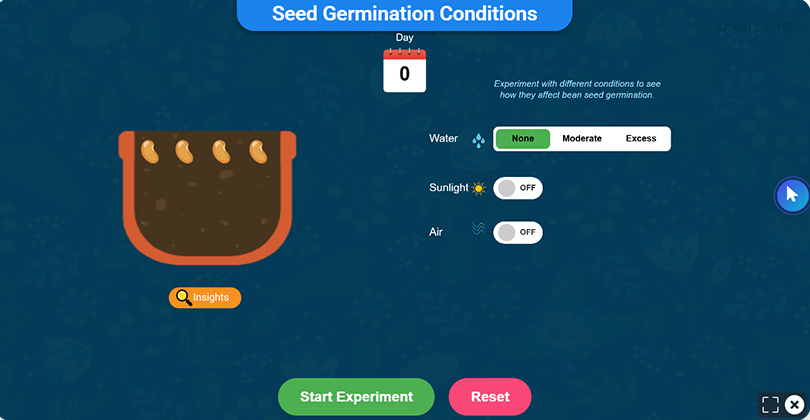
Interactive widgets from Tata ClassEdge Platinum that bring experiential learning into the classroom.
Looking Ahead
For schools, experiential learning is an opportunity to design learning environments where students are not only taught concepts but given meaningful opportunities to explore and make sense of them.
For students, this means becoming more involved in the process of learning: questioning, experimenting, reflecting on what they encounter, and connecting new experiences with what they already know.
The role of schools is therefore not simply to provide more experiences, but to ensure that those experiences lead somewhere: towards deeper understanding, greater independence in learning, and the ability to make meaning from what they encounter.
References
- Bartle, E. (2015). Experiential learning: An overview. Institute for Teaching and Learning Innovation, The University of Queensland. https://itali.uq.edu.au/files/1264/Discussion-paper-Experiential_learning_an_overview.pdf
- Dewey, J. (1938). Experience and Education. Yale University Press. https://ia800400.us.archive.org/20/items/experienceeducat00dewe_0/experienceeducat00dewe_0.pdf
- Kolb, D. A. (1984). Experiential Learning: Experience as the Source of Learning and Development. Prentice Hall. https://www.researchgate.net/publication/235701029_Experiential_Learning_Experience_As_The_Source_Of_Learning_And_Development
- Prince, M. (2004). “Does Active Learning Work? A Review of the Research.” Journal of Engineering Education.
https://doi.org/10.1002/j.2168-9830.2004.tb00809.x