

For a child, learning to read with understanding is an important foundation for future learning. Yet, 55% of India’s school-going children cannot read and comprehend a short, age-appropriate text (World Bank, 2019). That single statistic sparks an honest conversation about Foundational Literacy and Numeracy, or FLN, which has become one of the most urgent priorities in Indian education.
Let’s take a closer look to understand what these foundational skills really are, and why it matters so much to every child.
What is Foundational Literacy and Numeracy (FLN)?
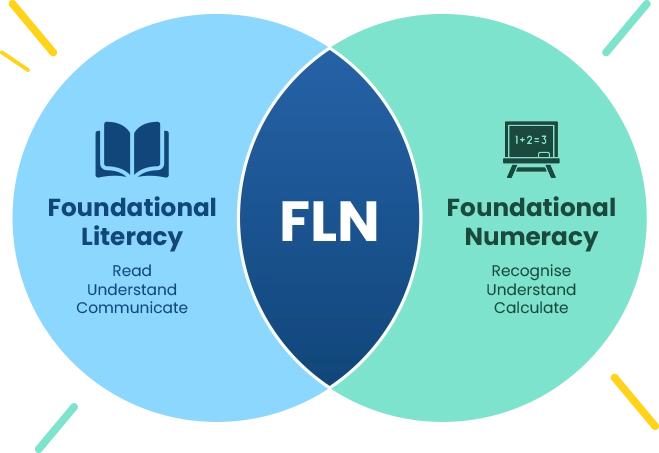
At its core, FLN refers to a child’s ability to read with understanding and handle basic arithmetic, typically by the end of Class 3. But the two halves of that phrase deserve to be unpacked separately.
Numeracy
Numeracy, broadly, is mathematical literacy: the capacity to formulate, use, and interpret mathematics across everyday contexts, not only inside a classroom (OECD, 2013). Foundational numeracy narrows this to what a child needs first: recognising numbers, understanding how they relate to one another, and completing basic calculations before moving on to more advanced topics (Ghosh, 2021; Ministry of Education, 2020).
Interestingly, early numeracy begins to develop even before formal schooling. Researchers distinguish between symbolic number skills, such as understanding that the word “three” and the numeral “3” represent the same quantity, and non-symbolic number skills, such as recognising which of two groups contains more objects without counting (Kumar & Behera, 2022; Raghubar & Barnes, 2016). Both forms of understanding tend to develop side by side, well before a child ever sits in a classroom.
Non-symbolic
number skills

Recognising which group has more objects without counting
Symbolic
number skills
3 = Three
Understanding that the word “three” and the numeral “3” represent the same quantity
Literacy
Literacy, broadly, is the ability to comprehend, apply, and reflect on written material well enough to read, write, and speak fluently. Foundational literacy narrows this to what a child needs first: identifying letters, reading familiar words, and producing various forms of communication (Torgesen et al., 2001).
This groundwork also begins well before formal reading instruction, built on three components: print knowledge, or recognising letters; oral language, covering vocabulary, grammar, comprehension; and phonological awareness, the ability to notice and manipulate the different language parts, such as words and syllables (Napoli & Purpura, 2018; Whitehurst & Lonigan, 1998; Missall et al., 2006), for instance, recognising that “cat” and “hat” rhyme.
Print knowledge
Recognising letters and understanding print.
Oral language
Vocabulary, grammar and comprehension.
Phonological awareness
Recognising and manipulating sounds, words, syllables.
The objective, put simply, is to instil language and mathematics competency in learners and build the basic skills and understanding that everything else in school depends on. Children first learn to read, so that later, they’re able to read to learn.
Why does it matter?
Why Early years carry so much weight?
The research behind FLN points to two converging reasons why these years matter so much.
The first is developmental. Over 85% of a child’s cumulative brain development takes place by the age of six, which places the foundational years, roughly between ages three and seven, as the single most important window for building the skills described above. This is echoed globally, too. The United Nations’ Sustainable Development Goal 4 has set an explicit target for universal foundational literacy by 2030, treating this as a baseline requirement for equitable education. For teachers working in the early years, this makes the classroom a particularly important space for identifying and strengthening these foundational skills. It also highlights the importance of noticing gaps early rather than waiting for them to become more difficult to address in later grades.

The second reason is predictive. Morgan et al. (2009) found that 70% of children who scored below the tenth percentile in mathematics at the start of kindergarten were still below that percentile by Grade 5, a finding echoed by subsequent research linking early numeracy to long-term mathematical achievement (Aunola et al., 2004; Duncan et al., 2007).
In other words, a foundational gap that opens early does not tend to close on its own. It compounds, and it is worth taking seriously.
India’s current FLN levels
Governmental and non-governmental surveys indicate that India is presently in a learning crisis. A large proportion of students in elementary school (estimated to be over five crores) have not achieved FLN. They cannot read or perform basic addition and subtraction with numerals. The 2021 National Achievement Survey (NAS) found that learning levels in language and mathematics among Grade 3 children are substantially below the national average in 18 of the 29 states surveyed. The national mean scores were 323 out of 500 in language and 306 out of 500 in mathematics. More recent data tells a similar story: ASER (2023) found that in 2022, only 25% of Grade III children were at ‘grade level’ in mathematics and about 20% in reading. This means that most children need urgent help in acquiring foundational skills in literacy and numeracy.
Learning levels in Grade 3 (ASER 2023)
Language

Only 20% of Grade 3 students are at or above the grade level in language.
Mathematics

Only 25% of Grade 3 students are at or above the grade level in mathematics.

An estimated
5+ crores
of students in elementary school
have not achieved FLN Skills
India’s FLN Priorities:
From Policy to Classroom Practice
India has the mission to ensure that every child attains foundational literacy and numeracy (FLN) skills by the end of grade 3. The National Mission on FLN works under the remit of the Ministry of Education (MoE) to attain universal FLN in all primary schools. The MoE has identified stage-wise targets and goals to be achieved by 2025.
The National Initiatives for Proficiency in Reading with Understanding and Numeracy (NIPUN Bharat; MoE, 2020) closely track and monitor the same progress to ensure that every child in the country attains FLN by the end of 3 three by 2026–2027. The focus is based on competency-based learning and the universal acquisition of FLN skills.
Translating this into classroom practice could look like:
01

Setting stage-wise, trackable targets for literacy and numeracy rather than relying only on a single end-of-year goal.
02

Anchoring classroom instruction in competency-based learning rather than focusing primarily on coverage of content.
03

Creating regular opportunities for children to develop foundational skills through meaningful reading, language, and numeracy activities.
04

Using regular, low-stakes assessments to identify foundational gaps early, while they are still easier to address.
05

Aligning teaching resources and professional development with specific foundational skills, such as phonological awareness, vocabulary, comprehension, and number understanding.
06

Creating structured opportunities for parents to reinforce children’s early literacy and numeracy development at home.
Looking Ahead
NEP 2020 and NIPUN Bharat treat FLN as a shared responsibility. Consequently, schools and governments must collaborate to enhance policy frameworks supporting parental involvement in education. The Government of India (2020), through the NEP, has emphasised the importance of parental involvement in addressing the country’s learning crisis, with a particular focus on FLN. (Srinivas et al., 2025). This emphasis is supported by research demonstrating that the home learning environment provided by parents is closely associated with children’s cognitive outcomes (Niklas et al., 2016).
For school leaders, the focus need not be on adding another initiative to an already demanding agenda. It is about creating the conditions for teachers to give foundational learning the attention it requires, through appropriate time, resources, professional development and regular assessment. For teachers, this means being intentional about the everyday decisions that shape early learning, from how reading is taught to how numbers are introduced, and using evidence of children’s learning to identify and address gaps early.
References
- Kumar, M., & Behera, B. (2022). Influence of home environment on children’s foundational literacy and numeracy skills: A systematic synthesis with India in focus. Asian Journal for Mathematics Education, 1(3), 359–380.
https://doi.org/10.1177/27527263221129366 - Srinivas, K., Bhattacharyya, H., Banoo, H., Touthang, N., & Bika, S. L. (2025). Parental support for foundational literacy and numeracy skills among schoolchildren: A case study from India. Social Sciences & Humanities Open, 12, 101998. https://doi.org/10.1016/j.ssaho.2025.101998
- ASER Report. (2023).
https://www.asercentre.org/ - Ministry of Education, Government of India. (2020). National Education Policy 2020.
https://aicte.gov.in/sites/default/files/nep2020.pdf - PIB Press Release.
https://www.pib.gov.in/PressReleasePage.aspx?PRID=2291340®=48&lang=2
Frequently Asked Questions (FAQs)
What is the full form of FLN?
FLN stands for Foundational Literacy and Numeracy.
What is NIPUN Bharat?
NIPUN Bharat stands for National Initiative for Proficiency in Reading with Understanding and Numeracy. It is a national initiative aimed at ensuring that every child attains foundational literacy and numeracy by the end of Grade 3.
What is the target year for India to achieve universal FLN?
Under NIPUN Bharat, India aims to ensure every child attains foundational literacy and numeracy by 2026–27.