


For a student preparing for competitive exams, the months before the exam can feel like a blur of textbooks, notes, and revision cycles. Along with completing a huge syllabus, it demands the ability to perform accurately, quickly, and under considerable pressure within the constraints of a high-stakes exam environment. Yet most preparation strategies focus almost entirely on content coverage, leaving one critical gap unaddressed: the experience of the exam itself.
Preparation goes beyond content coverage
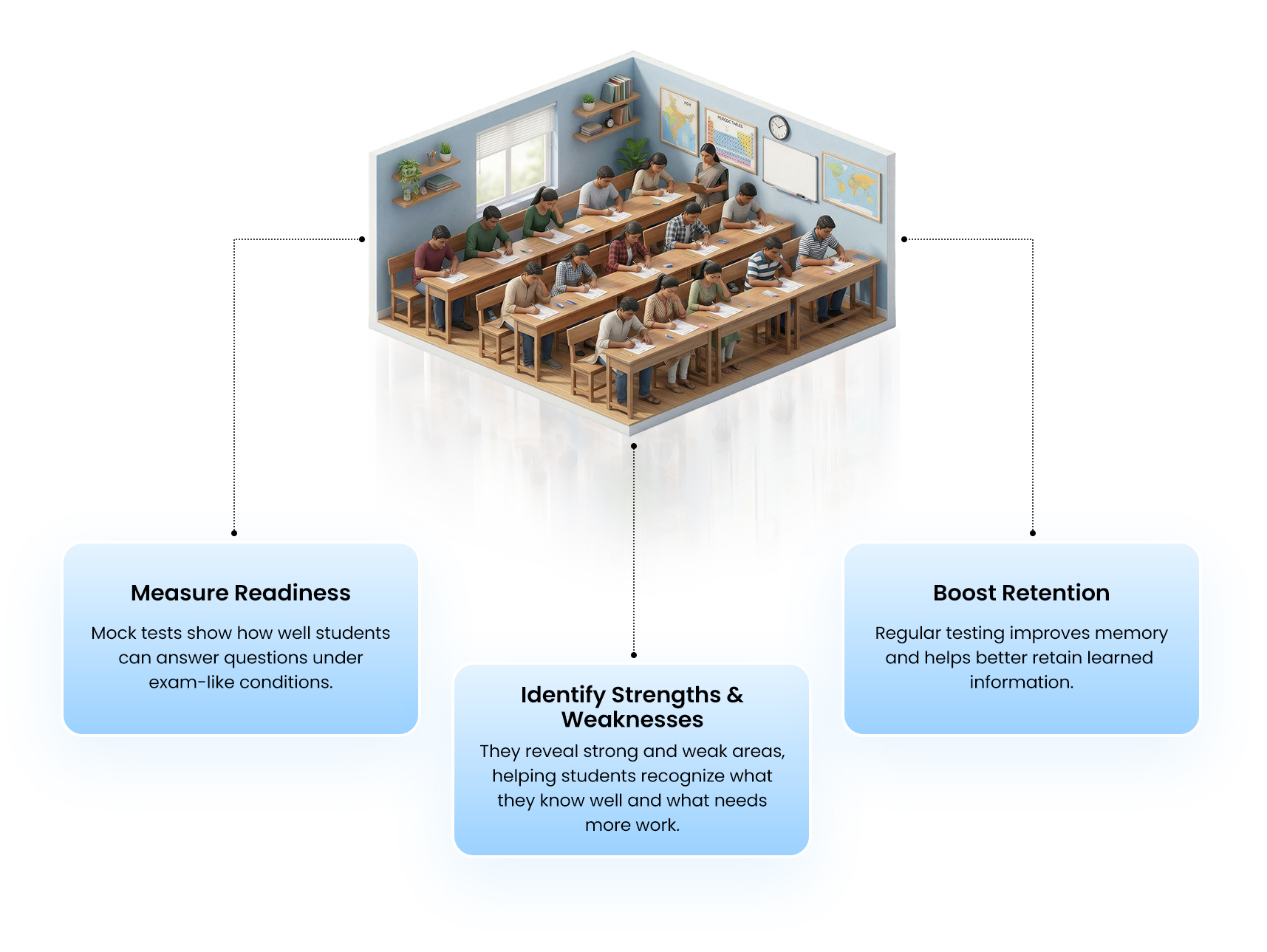
Research shows that the benefits of testing are consistent across decades and study designs: retrieval practice enhances long-term retention, practice under test-like conditions improves performance and readiness, and feedback further accelerates learning (Roediger & Karpicke, 2006; Rowland, 2014).
For aspirants targeting NEET or MHT-CET, where the margin between a qualifying and a competitive score is small, preparation without regular, structured practice tests leaves a critical gap.
Mock tests measure actual exam readiness
Practice tests sharpen a student’s ability to accurately judge their own understanding. Research has found that students who are regularly tested not only perform better on delayed assessments but also develop greater accuracy in judging what they know and do not know (Barenberg & Dutke, 2019).
For NEET and MHT-CET aspirants, this matters enormously. A student who can accurately identify which topics they have mastered, and which are weak, is in a fundamentally stronger position than one who feels broadly confident but cannot locate their own gaps.
Simulation reduces anxiety
Competitive entrance exams are not just knowledge tests. They are endurance and composure tests. Research in educational psychology consistently shows that familiarity with exam conditions reduces stress and its impact on performance (Vogel & Schwabe, 2016).
Students who have already experienced the format, the pacing, the pressure of a ticking clock, and the weight of high-stakes decision-making approach the actual exam with far greater composure.
This is precisely where the distinction between home-based practice and a test centre exam becomes critical. Solving past papers at your own desk, pausing when needed and reviewing answers at leisure is a useful revision activity, but it is not the same as sitting in an exam hall with invigilators, a fixed start time, no option to pause, and the psychological reality that performance counts.
Research shows that students who took tests in an unfamiliar mode performed significantly below their actual level of preparation, and the gap narrowed only in the second year, once they had become accustomed to the format (Backes & Cowan, 2019).
A test centre mock that replicates the actual competitive exam environment assesses not only knowledge, but also the psychological and strategic dimensions of performance that cannot be simulated at home.
Feedback closes the loop
Research establishes that retrieval practice, combined with accurate feedback, allows students to better calibrate their knowledge. It helps identify not just what they got wrong, but why their confidence was misplaced (Dunlosky et al., 2013).
Timely, transparent feedback with detailed solutions, clear answer keys, and the ability to review performance objectively allows students to redirect their preparation precisely where it is needed, rather than continuing to revise topics they already understand.
References
- Barenberg, J., & Dutke, S. (2019). Testing and metacognition: Retrieval practice effects on metacognitive monitoring in learning from text. Memory, 27(3), 269–279. https://doi.org/10.1080/09658211.2018.1506481
- Backes, B., & Cowan, J. (2019). Is the pen mightier than the keyboard? The effect of online testing on measured student achievement. Economics of Education Review, 68, 89–103. https://doi.org/10.1016/j.econedurev.2018.12.007
- Dunlosky, J., Rawson, K. A., Marsh, E. J., Nathan, M. J., & Willingham, D. T. (2013). Improving students’ learning with effective learning techniques: Promising directions from cognitive and educational psychology. Psychological Science in the Public Interest, 14(1), 4–58. https://doi.org/10.1177/1529100612453266
- Roediger, H. L., III, & Karpicke, J. D. (2006). The power of testing memory: Basic research and implications for educational practice. Perspectives on Psychological Science, 1(3), 181–210. https://doi.org/10.1111/j.1745-6916.2006.00012.x
- Rowland, C. A. (2014). The effect of testing versus restudy on retention: A meta-analytic review of the testing effect. Psychological Bulletin, 140(6), 1432–1463. https://doi.org/10.1037/a0037559
- Vogel, S., & Schwabe, L. (2016). Learning and memory under stress: Implications for the classroom. npj Science of Learning, 1, 16011. https://doi.org/10.1038/npjscilearn.2016.11